

Believe
Then Jesus said, “Did I not tell you that if you believe, you will see the glory of God?”

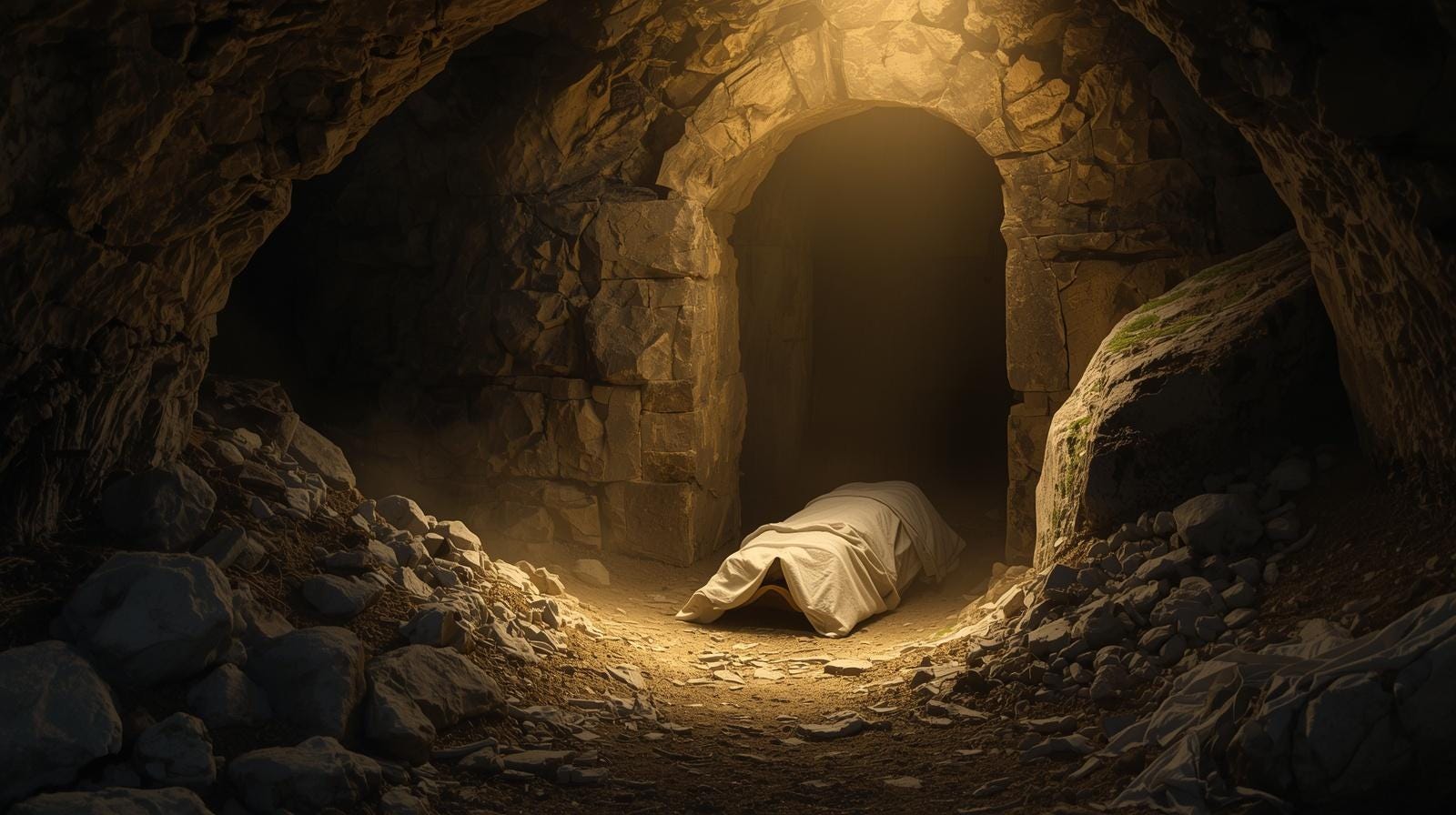
John 11:40-44 (NIV)
40 Then Jesus said, “Did I not tell you that if you believe, you will see the glory of God?”
41 So they took away the stone. Then Jesus looked up and said, “Father, I thank you that you have heard me. 42 I knew that you always hear me, but I said this for the benefit of the people standing here, that they may believe that you sent me.”
43 When he had said this, Jesus called in a loud voice, “Lazarus, come out!” 44 The dead man came out, his hands and feet wrapped with strips of linen, and a cloth around his face.
Jesus said to them, “Take off the grave clothes and let him go.”
The Stone
Lazarus has been dead for four days. Martha has come to meet Jesus on the road and told Him if He had been here, her brother would not have died. Mary has come and fallen at His feet with the same words. Jesus has wept — the shortest verse in the gospel, two words, carrying the full weight of the God who enters the grief of the people He loves rather than observing it from a distance.
And now He is at the tomb.
Take away the stone.
Martha objects immediately. But Lord, by this time there is a bad odour, for he has been there four days. It is the most practical objection in the scene — the objection of someone who loves the dead man but has accepted the reality of the death. Four days. The smell. The decomposition that has begun. Whatever she hoped for when she ran out to meet Jesus on the road, she is not expecting what He is about to do.
Jesus turns to her with a question that frames the whole of what follows.
Did I not tell you that if you believe, you will see the glory of God?
The stone is not the obstacle to the miracle. The obstacle to seeing the miracle is the stone left in place by unbelief — the practical, reasonable, smell-based calculation that what is dead is dead and opening the tomb will only confirm it. The stone comes down when believing that something is possible makes the removal worth doing.
They take away the stone.
The Prayer That Was Not For God
Father, I thank you that you have heard me. I knew that you always hear me, but I said this for the benefit of the people standing here, that they may believe that you sent me.
The transparency of this prayer is remarkable. Jesus does not pretend that the spoken prayer is His means of accessing the Father’s power — He has already been in communication with the Father about Lazarus. The earlier part of the chapter makes clear that Jesus knew what He was going to do before He arrived, that He delayed deliberately so that what happened would be beyond what anyone could attribute to medicine or natural recovery, that the purpose of the whole situation was that the Son of God might be glorified through it.
The spoken prayer at the tomb is for the crowd. Not because Jesus needs to pray aloud for God to act — but because the crowd needs to hear the address, needs to see the relationship between the prayer and the action, needs to understand that what is about to happen is not a feat of human power or religious technique but the response of the Father to the Son. The prayer is a window. It lets the people standing there see what is actually happening — not a miracle performed by an impressive man but the Father working through the Son whom He always hears.
That they may believe that you sent me.
This is the stated purpose of the prayer. Not the miracle itself — the miracle is in service of something larger. The raising of Lazarus is a sign, the seventh and greatest sign in John’s gospel, pointing toward the one performing it. Lazarus will die again. The life Jesus is restoring is a temporary restoration. But the belief that the raising produces — the recognition that this man was sent by God, that He is who He claims to be — that has consequences that outlast Lazarus’s second life.
Come Out
Jesus called in a loud voice, “Lazarus, come out!”
Three words in the original Greek. Lazare, deuro exo. Lazarus, come here outside. The command is direct, personal, named. Not a general declaration over the tomb. Not a prayer asking God to raise Lazarus. A direct address to the dead man by name — the same quality of calling that the shepherd parable described, the same naming that the lost sheep experienced, the same personal address that runs through every encounter Jesus has in John’s gospel.
The voice that spoke creation into existence in the beginning. The voice through which all things were made. That voice, calling into a tomb, into a condition of four-day decomposition, into the deepest silence that exists.
The dead man came out.
The response of death to the voice of the one in whom is life. Not gradual, not partial, not qualified by the four days or the grave clothes or the sealed tomb. He came out. Still wrapped in the linen strips, the cloth still around his face, moving in whatever way a man wrapped in burial cloth can move — but moving. Out of the tomb. In response to the voice.
The detail of the grave clothes matters. He came out still wearing the evidence of his death. Still wrapped. The miracle was real and complete — he was alive — but he came out carrying the marks of where he had been, needing the next instruction to be free of them.
Take Off the Grave Clothes
Jesus said to them, “Take off the grave clothes and let him go.”
The raising was Jesus’ work alone. No one else could have done it. No one else was asked to do it. The voice that called Lazarus out of the tomb was the voice of the one in whom life resides, and the command was His to give and His alone to give effectively.
But the unwrapping is given to the people standing there.
This is a division of labour that is worth sitting with carefully. Jesus does what only Jesus can do — He calls the dead man back to life. But the removing of what bound him in death, the freeing of him to move fully in the life he has been given back — that is left to the community. To the hands of the people who loved him, who had mourned him, who had stood weeping at the tomb.
The grave clothes are the residue of death on a man who is now alive. They are real — the linen strips, the face cloth, the binding that was appropriate for a corpse and is now the obstacle to the full expression of the life restored. Jesus could presumably have removed them as easily as He raised the man. He chooses not to. He assigns the unwrapping to the people who are there.
The church has always understood something in this. That the raising — the new life, the salvation, the regeneration — is entirely the work of God. No human hands bring someone from death to life. But the unwrapping — the ongoing work of freeing the newly alive person from the grave clothes of the old life, the supporting and the community and the accountability that allows the life to be expressed fully — that is work Jesus assigns to the people standing around the tomb.
Let him go. The goal is freedom. Not just life — life that is free to move, to walk, to be present in the world without the binding of death still around the feet and hands and face. The unwrapping serves the going. The community’s work is in service of the freedom of the one who has been raised.
If You Believe, You Will See
The sequence in this passage runs counter to the way we typically think about belief and evidence.
The natural instinct is to see first and then believe. Show me and I will believe. Prove it and I will trust it. Give me the evidence before you ask for the faith. Martha’s objection at the stone was this instinct in practical form — four days, bad odour, the stone should stay because opening it will only confirm what we already know.
Jesus reverses the sequence. If you believe, you will see the glory of God.
The stone comes down because they are willing to act on the possibility that something is about to happen that makes removing it worth the risk of disappointment. The prayer is spoken aloud so that the crowd can understand the relationship between the address to the Father and the action that follows. The command goes to the tomb because the one giving it believes — with a certainty that belongs to the one who was with the Father in the beginning — that the voice will be heard inside.
The seeing follows the believing. Not in the sense that belief manufactures the miracle — the miracle is entirely the work of the Father through the Son. But in the sense that the posture of faith is what creates the conditions in which the miracle can be received and recognised for what it is. The stone left in place by unbelief would have kept everyone outside the tomb. The stone removed by the obedience of faith is what makes the coming out visible.
This is the pattern throughout John’s gospel. The disciples believed and then understood more fully at the resurrection. The man born blind came and washed — the act of trust — and then came back seeing. The servants at Cana filled the jars and drew out what had become wine. In each case, the action of faith precedes the full visibility of what God is doing.
The Largest Sign Pointing the Farthest Forward
Lazarus will die again. The miracle at Bethany is not the ultimate miracle — it is the sign that points toward the ultimate miracle. A man raised from four days of death and brought back into ordinary mortal life. Jesus raised from three days of death into a life that death cannot touch again. The first is the pointer. The second is what it was pointing toward.
And because the raising of Lazarus points forward, the crowd watching it should have been able to follow the pointer. The sign said — the one who did this has authority over death. Not just the authority to delay it or to restore temporarily. The authority to call the dead by name and have them come out.
Which means that when this same one goes to the cross — when the crowd and the religious leaders and the Roman soldiers and the darkness itself seem to have the final word over the one who raised Lazarus — the sign at Bethany is still pointing. The voice that called Lazarus out of the tomb is the voice that will not stay silent in its own. The one who said I am the resurrection and the life is about to demonstrate it not by raising someone else but by walking out of His own grave.
Lazarus came out in grave clothes. Jesus left His in the tomb.
Walk On
This passage holds the full sweep of what Jesus came to do and narrows it to a specific moment at a specific tomb for a specific man whose name Jesus called.
The God who so loved the world that He gave His one and only Son is the same God who stood at Lazarus’s tomb and wept. The light of the world who shines in the darkness is the same one who looked into the darkness of a sealed tomb and called a name. The shepherd who calls His own sheep by name is the same one who said Lazarus, come out.
He still calls by name. The voice that reached a four-day dead man in a sealed tomb is not diminished by distance or time or the particular depth of your own darkness. Whatever is sealed in your life — whatever has been given up for dead, whatever has been mourned and accepted as gone — is not beyond the reach of the voice that called Lazarus.
Did I not tell you that if you believe, you will see the glory of God?
Take away the stone. The removal is the act of faith that makes the seeing possible. It does not perform the miracle — the miracle belongs to the one who gave the command. But it is the act that puts you in a position to witness what the command produces.
And when the living thing comes out still wrapped in the grave clothes of where it has been — let the community do its work. Unwrap what needs unwrapping. Let go what needs to be let go. Until the one who has been raised can move freely in the life that has been given back.
Let him go.
All glory to God — forever and ever. Amen. 🤍
If this reflection spoke to you, consider subscribing to follow along my journey of faith, meditation, and rebuilding — one day at a time. Your support truly means more than you know. ❤️