

Furious Squall
A furious squall came up, and the waves broke over the boat, so that it was nearly swamped.

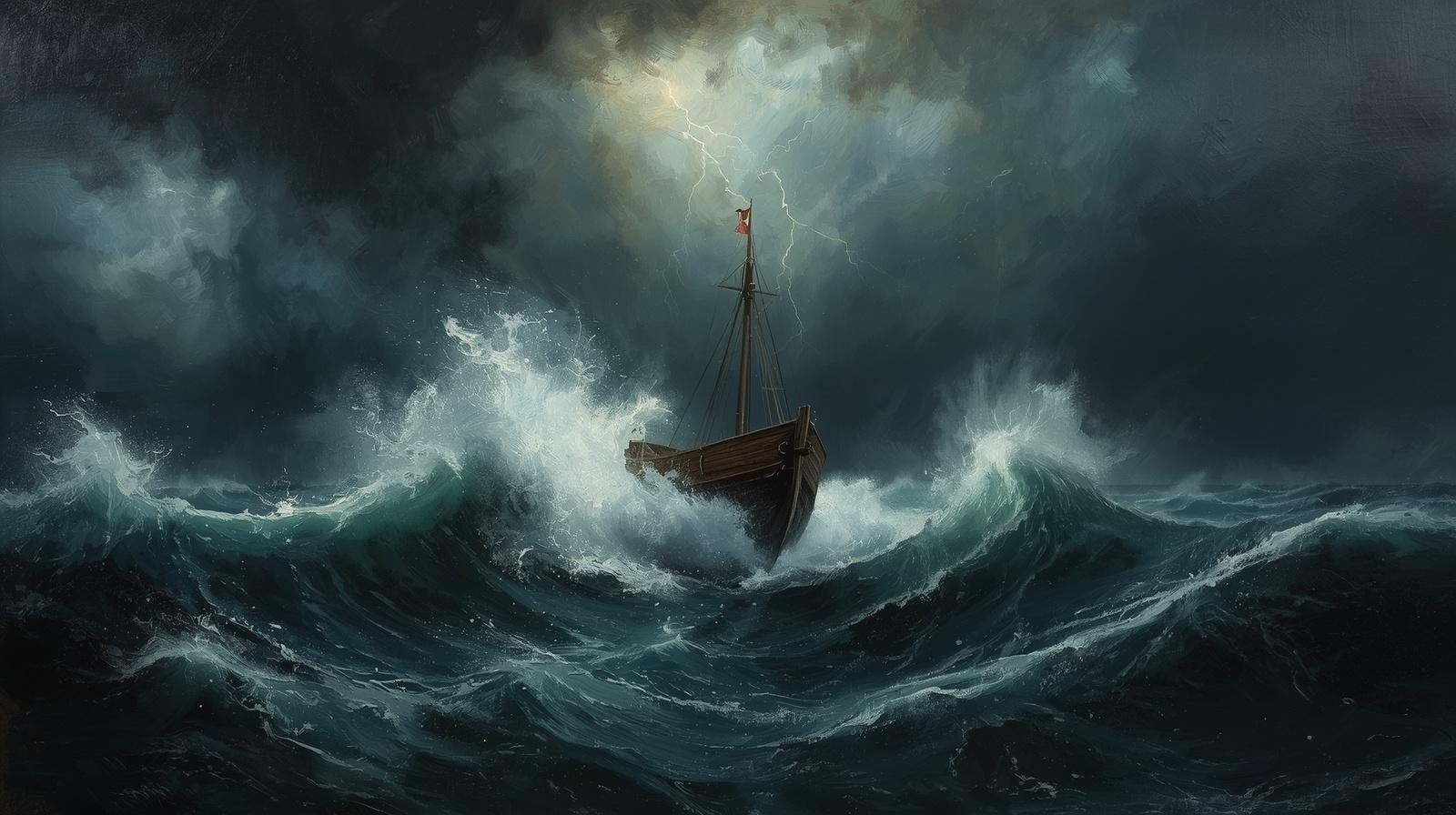
Mark 4:37-41 (NIV)
37 A furious squall came up, and the waves broke over the boat, so that it was nearly swamped. 38 Jesus was in the stern, sleeping on a cushion. The disciples woke him and said to him, “Teacher, don’t you care if we drown?”
39 He got up, rebuked the wind and said to the waves, “Quiet! Be still!” Then the wind died down and it was completely calm.
40 He said to his disciples, “Why are you so afraid? Do you still have no faith?”
41 They were terrified and asked each other, “Who is this? Even the wind and the waves obey him!”
The Crossing He Initiated
This storm did not catch Jesus off guard. He was the one who said — let us go over to the other side.
The disciples did not decide to cross the lake that evening. Jesus did. He gave the instruction, they got into the boat, and they went. Which means that everything that follows — the squall, the waves breaking over the sides, the boat nearly swamping — happened on a journey that Jesus himself initiated.
This is worth holding before anything else in the passage. The storm did not arrive because the disciples made a wrong turn or acted outside of God’s will. They were exactly where Jesus told them to be, doing exactly what He told them to do. And a furious squall came up anyway.
This is not an unusual experience for people who follow God. The obedient path is not a path guaranteed to be calm. The boat Jesus is in can still be hit by a storm. The place He has directed you toward can still require crossing water that turns violent. The fact that everything is falling apart around you is not necessarily evidence that you are in the wrong place. Sometimes it is evidence that you are in the right one — because the right place is wherever Jesus said to go, regardless of what the weather does on the way there.
Asleep on a Cushion
The detail Mark includes here is almost jarring in its specificity.
Jesus was in the stern, sleeping on a cushion.
Not sitting. Not watching the clouds. Sleeping. On a cushion. While the waves broke over the boat and the disciples fought to keep it from going under.
There is something in this image that resists easy domestication. The Son of God — the one through whom all things were made, including the sea and the wind — is asleep in the back of a fishing boat while His disciples are terrified. He is not absent. He is right there with them. But He is at rest in a way that they cannot access.
The peace Jesus has in that stern is not the peace of someone who does not know there is a storm. It is the peace of someone for whom the storm is not the most significant thing in the boat. He knows what the wind is. He made it. He knows what the waves can do. He set their boundaries. The storm is loud and it is real and it is genuinely dangerous — and none of that is enough to disturb the rest of the One who holds it all.
This is what the disciples are looking at when they wake Him. Not indifference. Not absence. But a quality of peace that the storm simply cannot reach.
Don’t You Care?
Teacher, don’t you care if we drown?
The question is soaked in everything the moment felt like to them. These were experienced fishermen — several of them had spent their lives on this lake. If they were frightened, the storm was serious. And in the middle of it, the person they had left everything to follow was asleep.
The accusation underneath the question is worth naming honestly. They are not just asking for help. They are asking whether He is indifferent to their suffering. Whether the fact that He is at peace means He has no regard for the fact that they are not. Whether His rest comes at the cost of His care.
It is a question people have asked in every generation. In the middle of the storms that will not stop — the situations that seem to be swamping the boat, the crises that arrive on journeys Jesus himself initiated — the question forms almost involuntarily. Does He know? Does He see? Does He care?
The answer Jesus gives is not a speech about His care. It is an action that demonstrates it. He gets up. He speaks to the wind and the waves. And then He addresses the question underneath the question — not the weather, but the faith.
Quiet. Be Still.
He got up, rebuked the wind and said to the waves — Quiet. Be still.
Two words in the original. Siopa. Pephimoso. Silence. Be muzzled.
He does not pray for the storm to stop. He does not appeal to the Father on behalf of the disciples. He speaks to the wind and the waves directly — with the authority of the one who set them in place to begin with. And they obey. Immediately. Completely. The wind dies. The water becomes glass.
The word rebuked is significant. It is the same word used elsewhere in Mark when Jesus confronts demonic forces. The storm is treated not as a neutral weather event but as something being addressed with authority. Whether that implies something more than meteorology is a question the text leaves open — but the authority Jesus exercises over it is unambiguous. Creation obeys its Creator. The elements that had been terrorising the disciples for hours fall silent at two words.
What the disciples could not do with all their effort and experience — what no amount of skilled seamanship could have resolved — was settled in a moment by the One who had been asleep in the stern.
Why Are You So Afraid?
The calm arrives. And then Jesus turns to His disciples.
Why are you so afraid? Do you still have no faith?
The questions land differently depending on how you hear them. They can sound like a rebuke — an impatient response to disciples who should have known better. But they can also be heard as genuine questions. Diagnostic rather than dismissive. Jesus is not condemning them for being human. He is pointing at something He wants them to see about the relationship between fear and faith.
Fear and faith are not simply emotions. They are orientations. Fear orients you toward the storm — its size, its power, its potential to destroy you. Faith orients you toward the One in the boat with you — His nature, His power, His presence. Both the storm and Jesus were in the boat that night. The disciples’ eyes were entirely on the storm.
Do you still have no faith? The word still is important. They had been with Him. They had watched what He did. They had heard what He taught. And in the moment of crisis, all of it receded and the storm filled everything. Faith is not the absence of evidence — the disciples had plenty of evidence. It is the practiced discipline of letting what you know about Jesus be louder than what the storm is saying.
That discipline does not come automatically. It is built in the ordinary days before the storm arrives. In the quiet crossings. In the teaching absorbed before the wind picks up. The disciples were still learning. So are we.
Who Is This?
The passage ends not with peace but with a deeper fear than the one they started with.
They were terrified and asked each other — who is this? Even the wind and the waves obey him.
The storm had frightened them. The calm frightened them more. Because the storm was something they had categories for. Dangerous weather on the Sea of Galilee was a known quantity. They understood what it was even if they could not stop it.
But a man who speaks to the wind and the waves and is obeyed instantly — they had no category for that. That was not the behaviour of a teacher or a prophet or even a miracle worker in the tradition they knew. That was the behaviour of the One who made the wind and the waves.
The question they ask each other — who is this — is the right question. It is the question the whole of Mark’s gospel is organised around. And the storm on the lake has pushed them closer to the answer than any calm day could have. It took the crisis to surface the question that the ordinary days had not yet forced them to fully confront.
Sometimes the storms that terrify us are the very things that bring us face to face with who Jesus actually is. Not the version we had comfortably accommodated into our existing understanding — but the One before whom wind and waves fall silent. The One whose nature, once glimpsed even partially, produces a reverence deeper than any storm could produce.
Walk On
Most of us know what it is to be in the boat when the squall comes up.
The journey Jesus initiated. The path we were certain we were supposed to be on. And then the water rising and the wind increasing and the boat beginning to fill — and the desperate, human question forming in the back of the mind. Does He care? Does He know? Where is He?
He is in the stern. Not absent — present. Not indifferent — at rest with a peace the storm cannot reach. And He is not unaware of what is happening around Him.
The invitation of this passage is not to manufacture a calm you do not feel. It is to bring the real question — the one underneath the panic — directly to Him. The disciples woke Jesus. That was the right move. Not the stoic silence of people pretending the storm is not real. The honest, desperate, even accusatory cry of people who know that He is the only one who can do anything about it.
He got up then. He is not less capable now.
Bring Him the storm. Let Him ask you about your faith. And stay in the boat long enough to hear the question that the calm makes possible — who is this — and let it take you somewhere deeper than the crisis brought you.
All glory to God — forever and ever. Amen. 🤍
If this reflection spoke to you, consider subscribing to follow along my journey of faith, meditation, and rebuilding — one day at a time. Your support truly means more than you know. ❤️