

Last Supper
While they were eating, Jesus took bread, and when he had given thanks, he broke it and gave it to his disciples, saying, “Take and eat; this is my body.”

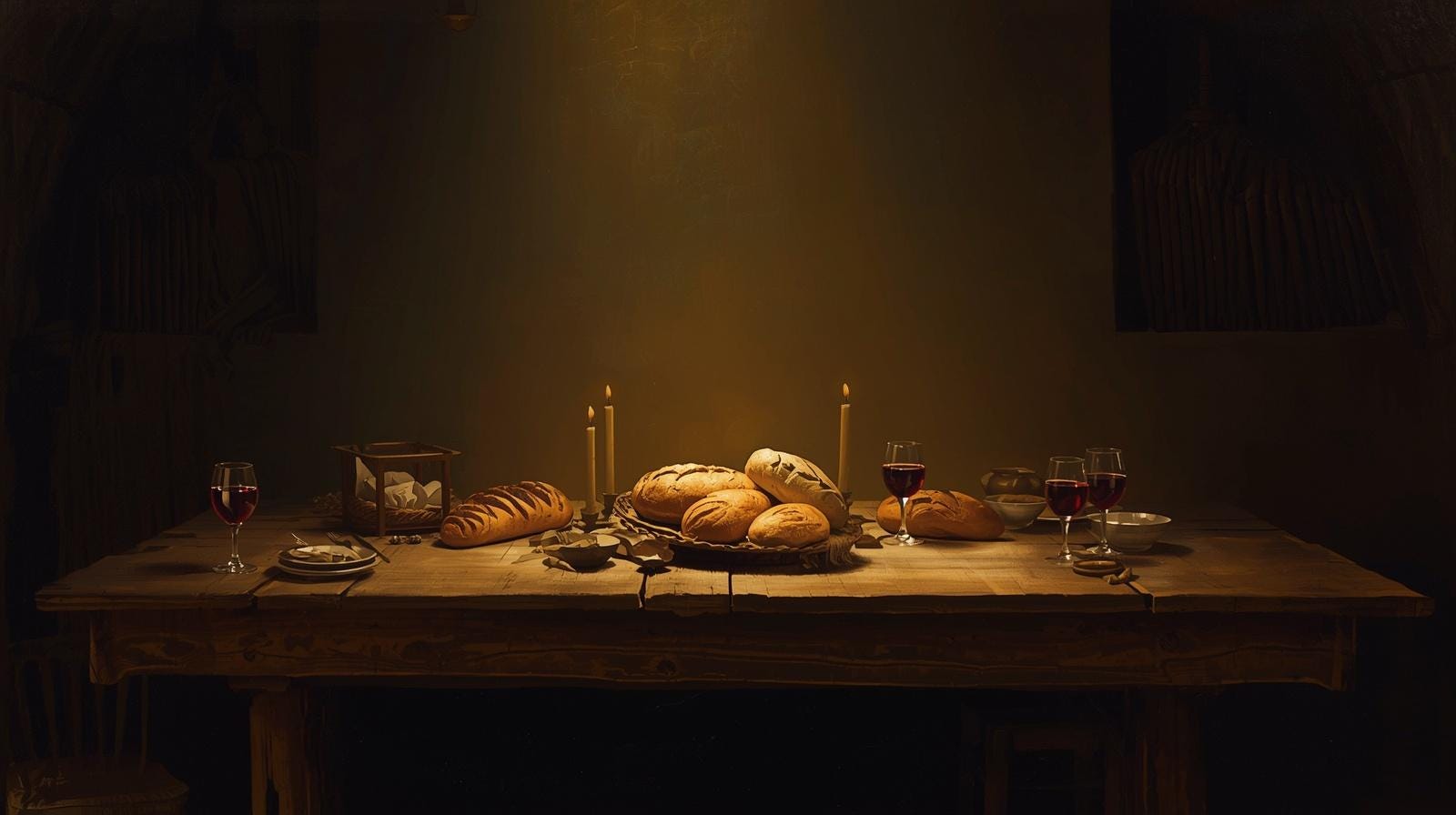
Matthew 26:26-30 (NIV)
26 While they were eating, Jesus took bread, and when he had given thanks, he broke it and gave it to his disciples, saying, “Take and eat; this is my body.”
27 Then he took a cup, and when he had given thanks, he gave it to them, saying, “Drink from it, all of you. 28 This is my blood of the covenant, which is poured out for many for the forgiveness of sins. 29 I tell you, I will not drink from this fruit of the vine from now on until that day when I drink it new with you in my Father’s kingdom.”
30 When they had sung a hymn, they went out to the Mount of Olives.
The Last Meal
This is one of the most intimate moments in the entire gospel.
The cross is hours away. Jesus knows what is coming — the arrest, the trial, the death. He has known it was coming for a long time. And yet here He is, at a table with His disciples, in the middle of a meal, doing something quiet and deliberate with bread and a cup.
He does not gather them for a final speech. He does not deliver a closing argument. He sits down to eat with them. And in the middle of that ordinary shared meal, He does something that will echo through every generation of the church that follows.
He takes the bread. He gives thanks. He breaks it. He gives it to them.
The simplicity of the action is part of what makes it so powerful. These were not unusual objects. Bread and wine were on every table. What Jesus does is take the ordinary and make it permanently extraordinary — not by replacing it with something more impressive, but by giving it a meaning it had never carried before.
This Is My Body
Take and eat. This is my body.
Theologians have debated for centuries exactly what Jesus meant by these words. That debate is real and the differences between traditions are not trivial. But before we reach for the theological controversy, it is worth sitting with what is actually happening in the room.
Jesus is about to give His body. Not metaphorically — physically, actually, in a way that will involve nails and a cross and death. And He is telling His disciples, before it happens, that the bread they are holding in their hands is connected to that. That when they eat it they are receiving something of Him. That this broken thing in their hands is a picture of what He is about to do with His whole self.
The breaking of the bread is not incidental. Bread that is broken can be shared in a way that whole bread cannot. It is the breaking that makes distribution possible. Jesus is about to be broken — and it is precisely through that breaking that what He is and what He carries will be made available to everyone who comes to Him.
Take and eat. The instruction is active. He does not ask them to observe the bread or think about it from a distance. He tells them to receive it. To take it in. To let what it represents become part of them.
Poured Out for Many
Then the cup.
This is my blood of the covenant, which is poured out for many for the forgiveness of sins.
Every word in this sentence is carrying weight.
Blood of the covenant reaches back to Exodus — to the moment when Moses took the blood of the sacrifice and sprinkled it on the people, saying: this is the blood of the covenant that God has made with you. That covenant was sealed in blood. And now Jesus is saying that what is about to happen to Him — the pouring out of His own blood — is the sealing of a new covenant. A new agreement between God and humanity, written not in the blood of animals on an altar, but in His own.
Poured out for many. Not kept. Not preserved. Poured out — the language of total expenditure. Everything given. Nothing held back.
For the forgiveness of sins. This is the purpose named clearly and without elaboration. Not for our improvement. Not for our inspiration. For forgiveness. For the removal of the thing that separates us from God. The debt is not being managed or deferred — it is being cancelled, at the cost of everything He has.
Until That Day
There is a sentence in this passage that is easy to move past too quickly.
I tell you, I will not drink from this fruit of the vine from now on until that day when I drink it new with you in my Father’s kingdom.
Jesus is not simply noting that He will not eat and drink again before the cross. He is making a promise. He is pointing forward — past the arrest, past the trial, past the death, past even the resurrection — to a day that is still coming. A day when He will sit at a table again with His own, and drink the fruit of the vine new, in the fullness of the Father’s kingdom.
The meal they are sharing now is incomplete. It is a foretaste, not the feast. The covenant being sealed tonight is moving toward something — a restoration, a reunion, a table that will not end. Jesus is telling His disciples, on the night of His betrayal, that the story does not end at the cross. It ends at a table. With Him. In the kingdom.
This is the hope that the broken bread and the poured-out cup are pointing toward. Not just backward to what He is about to do — but forward to what is still to come.
When They Had Sung a Hymn
Verse 30 is only one sentence. It is easy to read past it on the way to Gethsemane.
When they had sung a hymn, they went out to the Mount of Olives.
They sang.
Jesus knew what was waiting for Him on the other side of that door. The garden. The betrayal. The arrest. The death. And before He walked out into it, He sang with His disciples. Most likely one of the Hallel psalms — the psalms of praise that were traditionally sung at Passover. Psalms about God’s faithfulness. About deliverance. About the steadfast love that endures forever.
He sang them on His way to the cross.
There is something here that is difficult to fully take in. The courage of it. The faith of it. To walk toward the worst thing that will ever happen to you, singing about the faithfulness of God — not because the pain is not real, but because what you know about God is more real than the pain.
The hymn is not denial. It is defiance of a particular kind. It is the refusal to let what is coming have the last word before it has even arrived.
Walk On
This passage holds two directions at once — backward and forward.
Backward to the cross. To the body broken and the blood poured out for the forgiveness of sins. To the cost of what was done so that we could come to God without the weight of everything we have done and failed to do. That cost was real. It deserves more than a passing acknowledgement.
Forward to the table still to come. To the day Jesus described — when He drinks it new with His own in the Father’s kingdom. The meal on that night was a foretaste. What it points toward is the feast. And the promise of that feast is still standing.
In between those two directions is where we live. Taking the bread. Drinking the cup. Remembering what was done. Trusting what is coming. And — like Jesus on His way to the Mount of Olives — finding something to sing about even in the middle of the hard parts of the journey.
The covenant has been sealed. The price has been paid. The table is still ahead.
All glory to God — forever and ever. Amen. 🤍
If this reflection spoke to you, consider subscribing to follow along my journey of faith, meditation, and rebuilding — one day at a time. Your support truly means more than you know. ❤️