

Open Minds
Then he opened their minds so they could understand the Scriptures.

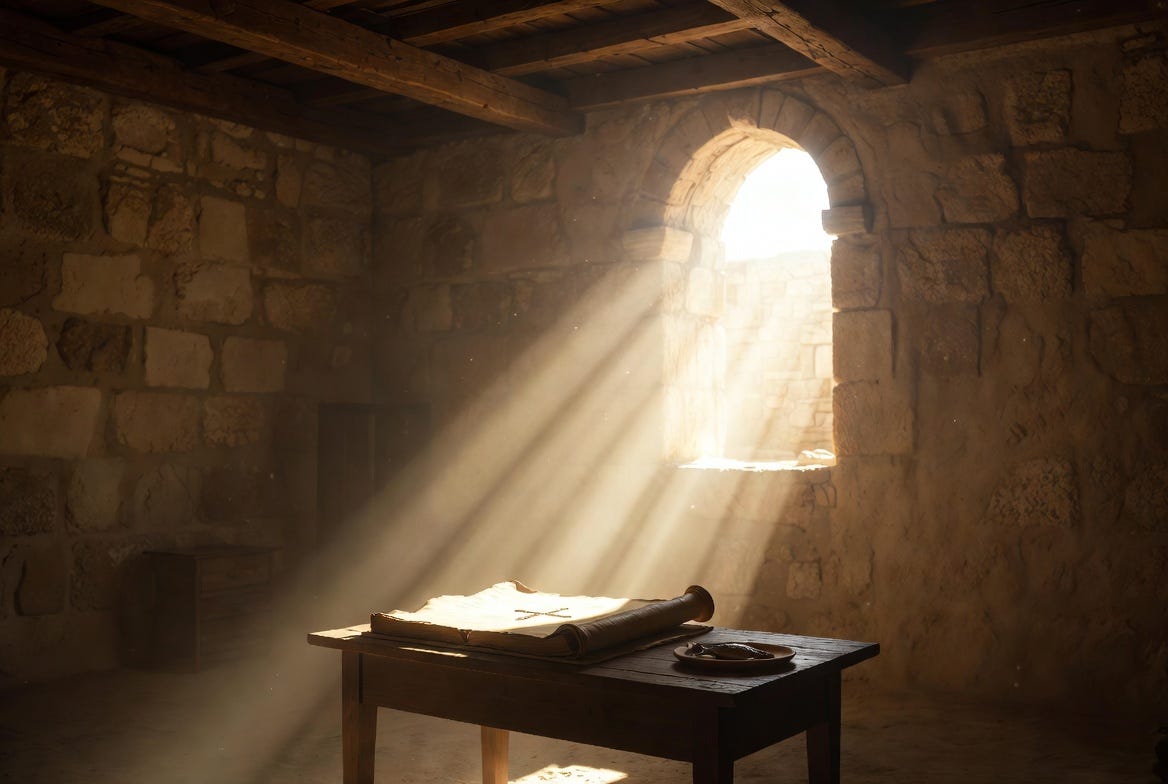
Luke 24:44-49 (NIV)
44 He said to them, “This is what I told you while I was still with you: Everything written about me in the Law of Moses, the Prophets and the Psalms must be fulfilled.”
45 Then he opened their minds so they could understand the Scriptures. 46 He told them, “This is what is written: The Messiah will suffer and rise from the dead on the third day, 47 and repentance for the forgiveness of sins will be preached in his name to all nations, beginning at Jerusalem. 48 You are witnesses of these things. 49 I am going to send you what my Father has promised; but stay in the city until you have been clothed with power from on high.”
The Same Room, Transformed
The disciples have just come through the most disorienting week of their lives.
The one they had left everything to follow was arrested, tried, and executed. The tomb was found empty. Women came back with reports of angels. Two disciples walked to Emmaus with a stranger who turned out to be Jesus and vanished at the moment of recognition. And now Jesus is standing in the room with them — real enough to show them His hands and feet, real enough to ask for food and eat a piece of broiled fish in front of them.
The same group that was hiding behind locked doors in fear is now being given the framework for everything that has just happened and everything that is about to happen. Jesus does not simply appear and reassure them that He is alive and leave them to figure out what it means. He teaches them. He opens their minds. He gives them the shape of the whole story so that what they are witnessing makes sense within the larger structure it belongs to.
The resurrection is not just an event to be marvelled at. It is the turning point of a narrative that has been running since Moses — and Jesus is making sure His disciples can read it as such before He sends them out to tell it to everyone else.
Everything Written About Me
This is what I told you while I was still with you: Everything written about me in the Law of Moses, the Prophets and the Psalms must be fulfilled.
The three divisions Jesus names — the Law, the Prophets, and the Psalms — is the way the Hebrew Scriptures were organised. The Law of Moses is the Pentateuch, the foundational five books. The Prophets include both the historical books and the prophetic literature. The Psalms stood at the head of what was called the Writings — the third division of the Hebrew canon. By naming all three, Jesus is saying the whole of Scripture. Everything. From beginning to end.
And He is saying it is about Him.
This is the claim that makes the resurrection not just a miracle but a meaning. A resurrection without this interpretive framework would be extraordinary but unanchored — a remarkable event without clear significance. The resurrection with this framework is the fulfillment of everything Scripture was pointing toward. The suffering Messiah of Isaiah 53. The son of David whose throne would have no end. The one David called Lord in Psalm 110. The prophet like Moses promised in Deuteronomy. The one whose bones would not be broken and whose garments would be divided by lot. All of it — every strand of the whole vast fabric of the Hebrew Scriptures — pointing here. To this room. To this person standing among them having come through death and out the other side.
The disciples had the Scriptures their entire lives. They had grown up hearing them read in the synagogue, had memorised portions of them, had understood them as the story of God and Israel. But they had not been able to see what the Scriptures were actually about — not until this moment.
He Opened Their Minds
Then he opened their minds so they could understand the Scriptures.
This is one of the most important sentences in the passage and it is easy to move past it quickly.
The understanding did not come from more information. They already had the information — they had heard the Scriptures their whole lives. The understanding came from the opening of their minds by Jesus. It was a gift, an act, something done to them rather than by them. The capacity to read Scripture correctly — to see the whole of it as pointing toward the Messiah who suffered and rose — was something Jesus gave them in that room.
This matters because it addresses a question that runs under the surface of the whole of Luke’s gospel. Why did the religious leaders — the people who knew the Scriptures most thoroughly, who had devoted their lives to studying and teaching them — why did they not see what the disciples eventually saw? Why did the scribes and Pharisees, with all their learning, arrive at the cross wanting Jesus dead rather than recognising Him as the fulfillment of everything they had been reading?
The answer is here. The understanding of Scripture that sees Jesus in every part of it is not the product of sufficient study. It is the gift of an opened mind. The Pharisees had the text. They did not have this. And without it, the most thorough knowledge of the words produces the most confident misreading of the story.
The disciples received the gift in this room. And the implication for everyone who reads Scripture since is that the same opening — the work of the Spirit illuminating the text — is what makes genuine understanding possible. Not intelligence. Not effort alone. The opened mind.
The Shape of the Story
Jesus gives them three things that the Scriptures said must happen — and that have now happened.
The Messiah will suffer. This was the part nobody had been able to absorb. The disciples had heard Jesus predict His death repeatedly and had not been able to receive it. The concept of a suffering Messiah ran so directly against the expectation of a triumphant deliverer that it could not find a place to land. Even after the crucifixion, the two disciples on the road to Emmaus described their shattered hope — we had hoped that he was the one to redeem Israel — as if the death had disproved the claim. The suffering was not the disqualification. It was always the point.
The Messiah will rise from the dead on the third day. The resurrection is not a reversal of the suffering — it is its completion. Death entered and then was entered by the one who holds life, and what came out the other side was not simply the resumption of the life that was interrupted but the beginning of a new kind of life that death cannot end. The third day was written into the story long before the third day arrived.
And repentance for the forgiveness of sins will be preached in His name to all nations, beginning at Jerusalem. The story does not end with the resurrection. The resurrection is the launch point. Everything that has happened — the suffering, the rising — is in service of this. The message that the Messiah has come, that forgiveness is available, that repentance opens the door to what God has done in Christ — this message is going out. To all nations. Starting in Jerusalem and moving outward until it reaches every corner of the earth. The scope of what is being commissioned is the scope of the whole world.
You Are Witnesses
You are witnesses of these things.
The word witnesses carries legal weight. A witness is not someone who has an opinion or a perspective or a report they heard from someone else. A witness is someone who was present. Who saw. Who can speak from direct experience of what actually happened.
The disciples are witnesses in both senses. They were present for the ministry — the healings, the teaching, the confrontations with the religious leaders, the feeding of thousands. They were present for the last week — the entry into Jerusalem, the upper room, the garden, the arrest, the trial, the crucifixion, the empty tomb, and now this room with the risen Jesus standing among them. They cannot be told they misunderstood or misremembered or constructed the story after the fact. They were there.
And their witness is what the proclamation to all nations will be built on. Not a theological argument constructed from first principles. Not a philosophical case for the existence of God. The testimony of people who were present. Who saw the hands and the feet. Who watched Him eat the fish. Who heard Him open the Scriptures and felt their minds opened in response.
The church that will go to all nations beginning at Jerusalem is built on the witness of people who were in this room. The gospel that will be preached to every nation is the testimony of people who cannot say anything other than what they saw.
Stay Until
And then the instruction that requires everything He has just told them to be held in trust while they wait for what comes next.
Stay in the city until you have been clothed with power from on high.
They have the framework. They have the witness. They have the commission — all nations, beginning at Jerusalem. What they do not yet have is the power to carry it out. The promise of the Father is coming. The Spirit Jesus has spoken of throughout the gospel — the one who will teach them all things, who will remind them of everything He has said — is coming. But not yet. Stay. Wait. The sending cannot precede the clothing.
This is not a delay out of divine inefficiency. It is the structure of what is about to happen. The witnesses who go out in their own strength will carry only what human strength can carry — and human strength is not sufficient for a commission that reaches to all nations. What is needed is the power from on high. The same Spirit who overshadowed Mary at the beginning of the gospel. The same Spirit who descended on Jesus at the Jordan. The same Spirit who led Him into the wilderness and through it. The witnesses need to be clothed in that same power before they go.
Pentecost is ten days away. They do not know that. They are being asked to stay in the city — to hold everything they have just been given, all the opened understanding and the witness and the commission — and wait for what the Father has promised.
Waiting in faith for a promise not yet fulfilled is itself a form of the watchfulness Jesus has been calling for throughout the gospel. They stay. They pray. They wait. And what comes will clothe them for everything that follows.
Walk On
This passage is the hinge on which the entire story turns.
Everything before it — the Law, the Prophets, the Psalms, the ministry of Jesus, the cross, the empty tomb — finds its meaning here. And everything after it — the book of Acts, the letters of Paul, the spread of the gospel to all nations, the church in every generation including this one — flows from here. From this room. From this opening of minds. From this commission given to witnesses who had been present for the whole of it.
We are downstream from this room. The witness that went out from Jerusalem has reached us — through the generations of the church, through the preserved text, through the same Spirit who opened their minds and is still opening minds today. The commission that was given in that room has not been completed. Every nation has not yet heard. Every person has not yet been reached.
And the instruction that was given then still applies to the church that is carrying the commission now. Do not go in your own strength. Wait for the clothing. Stay in the city — in the place of prayer, in the gathered community, in the attentiveness to the Spirit who empowers what human effort alone cannot accomplish.
Be clothed in power from on high. Then go.
The Messiah suffered. He rose. Repentance for the forgiveness of sins is to be preached in His name to all nations.
You are witnesses of these things.
All glory to God — forever and ever. Amen. 🤍
If this reflection spoke to you, consider subscribing to follow along my journey of faith, meditation, and rebuilding — one day at a time. Your support truly means more than you know. ❤️