

Remember Me
Jesus answered him, “Truly I tell you, today you will be with me in paradise.”

Luke 23:38-43 (NIV)
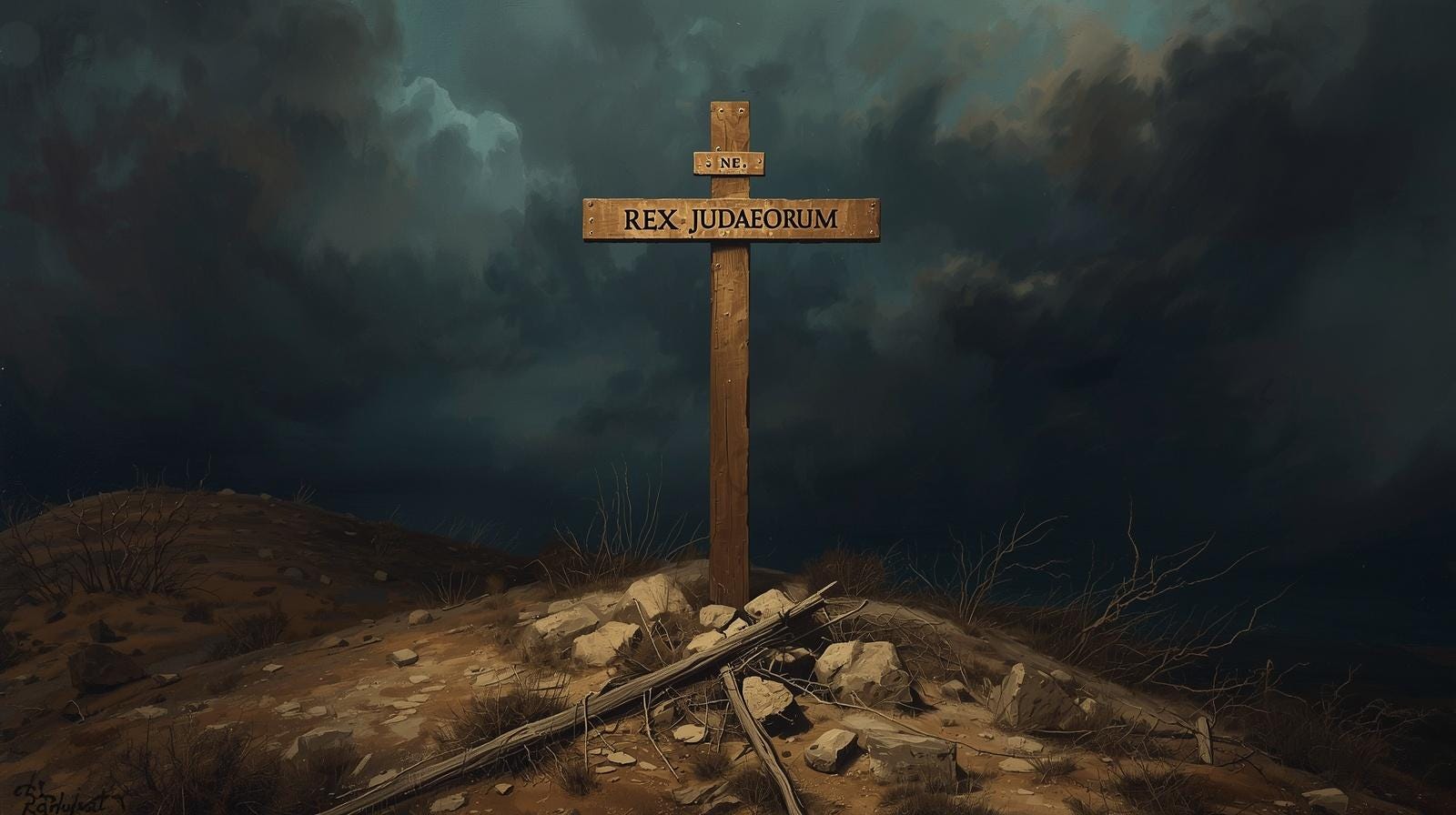
38 There was a written notice above him, which read: this is the king of the jews.
39 One of the criminals who hung there hurled insults at him: “Aren’t you the Messiah? Save yourself and us!”
40 But the other criminal rebuked him. “Don’t you fear God,” he said, “since you are under the same sentence? 41 We are punished justly, for we are getting what our deeds deserve. But this man has done nothing wrong.”
42 Then he said, “Jesus, remember me when you come into your kingdom.”
43 Jesus answered him, “Truly I tell you, today you will be with me in paradise.”
The Sign Above the Cross
The notice Pilate ordered placed above Jesus reads like an accusation meant to humiliate. This is the King of the Jews. The chief priests had objected — write that he claimed to be the King of the Jews, not that he is. Pilate refused. What I have written, I have written.
The irony that has run through the whole passion narrative reaches its peak here. The title meant as mockery is the most accurate description in the room. The sign nailed above a dying man in a place of public execution is the truest thing written about Him in the whole of Luke’s gospel. The King of the Jews is on the cross. And two criminals are dying on either side of Him.
This is the scene into which the second criminal speaks his request. Not a throne room. Not a moment of visible glory. A Roman execution, a crowd of mockers, a written notice of condemnation overhead, and a man dying between two thieves. And one of those thieves looks at the man beside him and sees a king.
Two Responses to the Same Cross
The two criminals are in identical circumstances. Same charge — or comparable ones. Same sentence. Same method of execution. Same view of Jesus dying between them. Same access to whatever they had heard about Him before this day. Same pain, same proximity, same approaching death.
And they respond in completely opposite directions.
The first hurls insults. Aren’t you the Messiah? Save yourself and us. The request sounds like a prayer but it is not. It is the same mockery the crowd below is offering — the soldiers who said save yourself, the rulers who said he saved others, let him save himself. The criminal is not asking to be rescued because he believes rescue is possible. He is taunting — using the language of Messianic expectation as a weapon. If you are who they say you are, prove it by getting us all down from here.
The second criminal rebukes him.
Don’t you fear God, since you are under the same sentence?
The rebuke is the beginning of a different kind of seeing. The first criminal looks at the cross and sees only what is in front of him — pain, humiliation, a man who cannot save even himself. The second criminal looks at the same cross and sees something that produces fear of God. Not terror — the reverent recognition that what is happening here is located within a larger frame than the immediate suffering suggests. That God is present. That they are dying and are accountable to someone before whom their lives will need to account for themselves.
We Are Punished Justly
We are punished justly, for we are getting what our deeds deserve. But this man has done nothing wrong.
This is one of the most honest statements in the entire passion narrative — and it comes from a dying criminal, not a disciple, not a religious leader, not a theological expert.
He does not excuse himself. He does not protest the injustice of his sentence or appeal to mitigating circumstances or argue that he is better than the charge suggests. He says plainly: we deserve this. What is happening to us is just. Our lives produced this outcome and the outcome is appropriate.
And then the contrast. But this man has done nothing wrong.
He has done his own theology from the cross. Without scrolls or synagogue, without years of training, dying in agony, he has arrived at the correct verdict on Jesus that the Sanhedrin and Pilate and the crowd have all failed to reach. The chief priests declared Him deserving of death. Pilate declared Him innocent three times and crucified Him anyway. The crowds called for His execution. The soldiers mocked Him. And this criminal, in the last hours of his life, says what is true — this man has done nothing wrong.
He is the only person at Calvary, apart from the women standing at a distance and the beloved disciple, who sees clearly. And he sees clearly not because he has more information but because he has been honest about himself first. The honesty about his own guilt is the same honesty that allows him to see the innocence of the one beside him. The person who cannot acknowledge what they actually are cannot see what Jesus actually is. The two perceptions are connected.
Remember Me
Then he said, “Jesus, remember me when you come into your kingdom.”
The request is extraordinary given everything that surrounds it.
He is not asking to be taken down from the cross. He is not asking for his life back, for the sentence to be commuted, for the pain to stop. He has assessed his situation accurately — he is dying and he knows it. What he is asking for is a place in something that is still coming. A kingdom that this dying man beside him will somehow enter. A future that lies on the other side of both their deaths.
The faith required to make this request is remarkable. The evidence available to him is a man being executed who cannot even save himself from the cross, above whose head hangs a sign that says King of the Jews in what everyone around them intends as a joke. And the criminal looks at this and asks to be remembered when the kingdom comes.
He has seen through the cross to something beyond it. He does not know about the resurrection — he cannot. He has not read the prophecies about the Messiah suffering and entering His glory. He has only the cross and the man dying on it and whatever combination of grace and perception has produced the conviction that this king is going somewhere after death that is worth asking to be included in.
Remember me. Not — save me now. Not — bring me down and let me live differently. Not — I will earn a place in your kingdom if you give me the chance. Just — when you get there, remember that I was here. That I was beside you. That I asked.
Today
The answer Jesus gives is not what the criminal asked for. It is infinitely more.
Truly I tell you, today you will be with me in paradise.
Not — I will remember you when I come into my kingdom. Not — your request has been noted and will be considered. Not a conditional or a qualified or a deferred response. Today. Not eventually. Not after a period of purification or a process of being made ready. Today — the same day the cross is happening, the same day the criminal is dying, before the sun sets on this particular Friday — you will be with me in paradise.
The word paradise reaches back to the Persian word for a walled garden — the image of a place of beauty and rest and safety, enclosed and protected from what is outside it. The Septuagint uses it for the Garden of Eden. The New Testament uses it for the immediate presence of God after death. Jesus is not promising the criminal a distant future reward. He is promising his company — with me — on the same day, in the same destination.
With me. Not just paradise in the abstract. The presence of Jesus. The one the criminal has just recognised as an innocent king going somewhere beyond death — the criminal is going there with Him. Today.
What He Brought
It is worth being precise about what the criminal brought to this exchange.
No prior discipleship. No record of following Jesus. No baptism. No sacraments. No years of faithful service. No time to go and live differently. No opportunity to demonstrate the sincerity of the turning by changed behaviour over time.
What he brought was this. An honest acknowledgment of his own guilt. A clear-eyed recognition of the innocence of Jesus. A rebuking of the mockery directed at Him. A request made in faith that Jesus was a king with a kingdom worth asking entry into. And a dying that he could not do anything about.
That was enough. More than enough. Jesus did not say — come back when you have had time to prove yourself. He did not say — your request is noted but the process requires more than a last-minute appeal. He said today.
The thief on the cross is the answer to every question about whether it is too late. Whether the distance is too great. Whether the life has been too compromised. Whether the request comes too close to the end to count for anything. The answer is the same answer it always has been throughout the gospel — the mercy runs toward the honest request. The justified person is the one who comes with nothing except the true assessment of themselves and the appeal to the one who has what they need.
The cross was not too late for the criminal. It was exactly the right moment. The last possible moment, as it turned out — but sufficient.
The Sign Was Right
This is the King of the Jews.
The sign Pilate would not change was telling the truth above the head of the one who was dying. And the criminal on the cross beside Him was the one person at Calvary who read the sign correctly — who looked at the dying man and saw the king, who looked at the cross and saw a kingdom, who made his request in the last hours of his life and received the fullness of what the kingdom had to offer.
Not because he was worthy. Because he asked the right person.
The same person who said whoever comes to me I will never drive away. Who went after the one lost sheep until He found it. Who told the woman at the well everything she had ever done and offered her living water anyway. Who said to Zacchaeus — today I must stay at your house. Who forgave Peter in the courtyard without Peter even asking yet.
That Jesus. The one on the cross. The one the sign names correctly above His dying head.
He remembered the criminal. He did not need to be asked twice.
Walk On
The criminal’s request is available to everyone reading this passage. Not as a last-resort prayer for the final hour only — but as the shape of the prayer that reaches Jesus at any point and in any condition.
Remember me. When you come into your kingdom. I am getting what I deserve. But you have done nothing wrong. And I believe you are going somewhere worth asking to be included in.
That is the whole of what the criminal offered. And what he received was today — the company of Jesus, the paradise that is His presence, the response of the king who does not defer what He can give immediately.
The cross that looked like the end of everything was the doorway through which the criminal entered the kingdom. The worst day in human history was the day one dying thief went to paradise.
Whatever this day looks like from where you are standing — whatever the sign above you seems to say, whatever the circumstance suggests about where things are headed — the one beside you on the cross is the King. And He is going somewhere. And the request He has never refused is still available.
Ask to be remembered. The answer is still today.
All glory to God — forever and ever. Amen. 🤍
If this reflection spoke to you, consider subscribing to follow along my journey of faith, meditation, and rebuilding — one day at a time. Your support truly means more than you know. ❤️