

Wash Feet
He came to Simon Peter, who said to him, “Lord, are you going to wash my feet?”

John 13:6-11 (NIV)
6 He came to Simon Peter, who said to him, “Lord, are you going to wash my feet?”
7 Jesus replied, “You do not realize now what I am doing, but later you will understand.”
8 “No,” said Peter, “you shall never wash my feet.”
Jesus answered, “Unless I wash you, you have no part with me.”
9 “Then, Lord,” Simon Peter replied, “not just my feet but my hands and my head as well!”
10 Jesus answered, “Those who have had a bath need only to wash their feet; their whole body is clean. And you are clean, though not every one of you.” 11 For he knew who was going to betray him, and that was why he said not every one was clean.
The Scene Before This
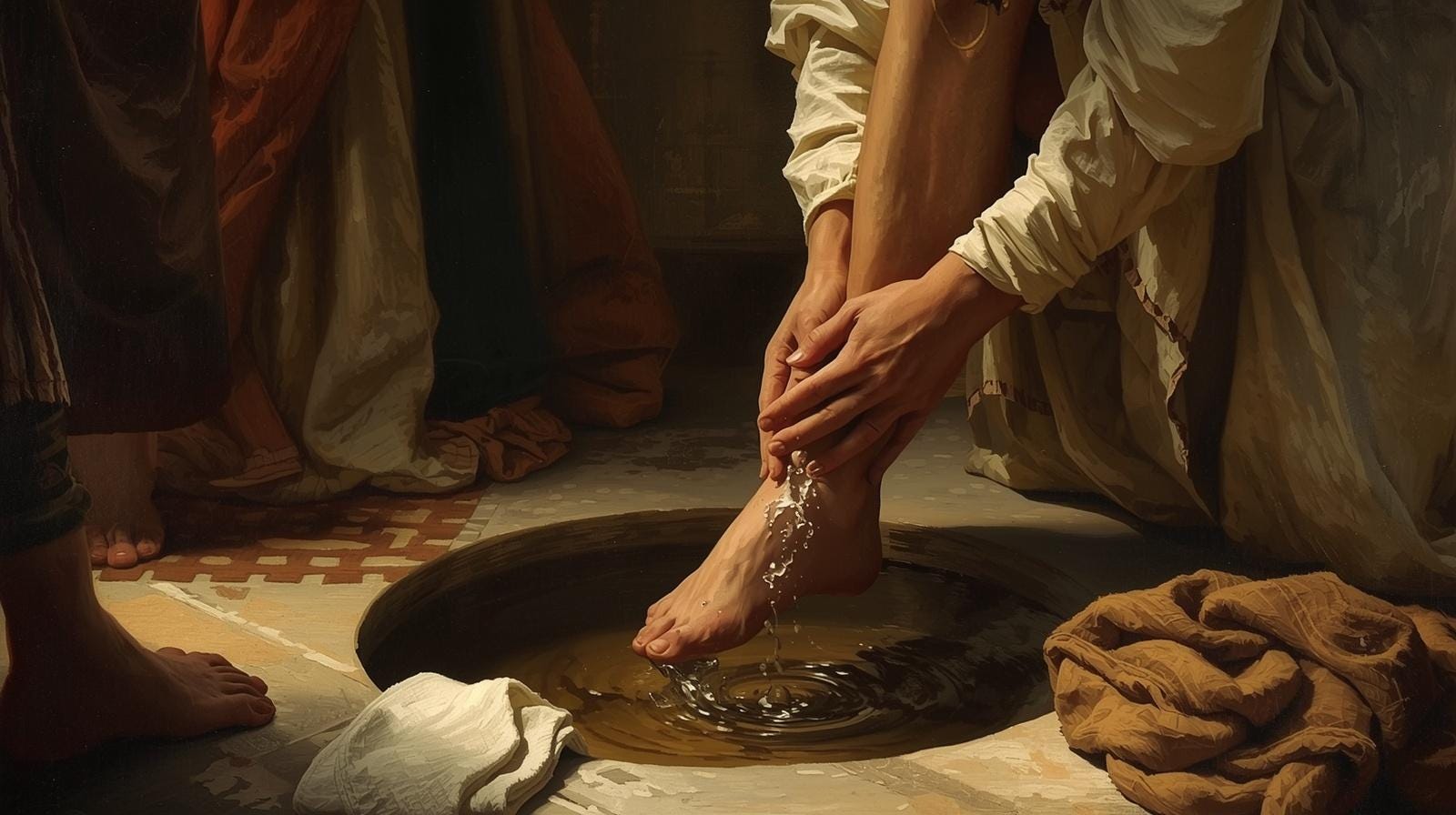
John tells us what Jesus knew as He got up from the meal. The Father had put all things under His power. He had come from God and was returning to God. With that full knowledge of who He was and where He was going — the same knowledge described back in John 8, I know where I came from and where I am going — He took off His outer clothing, wrapped a towel around His waist, and began to wash His disciples’ feet.
This is the lowest task in a first-century household — the job given to the lowest servant, the work of removing the dust and dirt of the road from feet that had walked unpaved ground in open sandals. It was not a job any guest expected to be done by the host, let alone by the host’s most distinguished guest. And it was certainly not a job anyone expected from the one the disciples had just confessed, days earlier, as the Messiah, the Son of God.
He does it anyway. With full knowledge of His own glory, He kneels at the feet of fishermen and tax collectors and takes the towel.
Lord, Are You Going to Wash My Feet?
When Jesus reaches Peter, the question comes out with the emphasis falling where it should. You are going to wash my feet? The categories are inverted in a way that Peter cannot process. The Lord does not wash the feet of the servant. The servant washes the feet of the Lord.
Jesus’ answer does not explain. You do not realize now what I am doing, but later you will understand. He does not unpack the symbolism in the moment. He asks for trust in advance of understanding — a posture that will become important again and again in Peter’s life, including in a far more painful context just a few hours later in a different courtyard.
Peter cannot wait for the later understanding. No, you shall never wash my feet.
Unless I Wash You
Jesus’ response cuts to the actual stakes of the moment.
Unless I wash you, you have no part with me.
This is not primarily a statement about hygiene. It is a statement about what the washing represents — the cleansing that only Jesus can perform, the act of grace that Peter cannot refuse and still remain in relationship with Him. Peter’s refusal, however well-intentioned, is a refusal of what Jesus came to give. The instinct behind it is humility — Peter does not feel worthy to have his Lord kneel before him. But the humility, in this instance, is misdirected. It refuses the gift rather than receiving it.
This is a pattern worth recognising. Sometimes what looks like humility is actually resistance — the unwillingness to be served, to be given to, to receive grace we have not earned and cannot reciprocate on equal terms. Peter wants to be the one doing the serving. He cannot yet accept being served by the one he has called Lord. And Jesus tells him plainly — that refusal, however sincere, severs the relationship rather than honouring it. You have no part with me.
Then Wash All of Me
Peter’s swing to the opposite extreme is entirely characteristic of him — and entirely understandable.
Not just my feet but my hands and my head as well!
If the washing is what secures his place with Jesus, then Peter wants the maximum possible washing. All of him. Every part. The same impulsiveness that led him to walk on water and declare he would die for Jesus is now applied to the foot-washing — go all the way, give me everything, do not stop at the feet.
Jesus’ answer corrects the overcorrection with precision.
Those who have had a bath need only to wash their feet; their whole body is clean.
The image is drawn from the practice of the day — a person who had bathed thoroughly before coming to a dinner would only need their feet washed upon arrival, since the feet alone had been exposed to the dust of the road in the time since the bath. The full cleansing had already happened. What remained was the incidental contact with the world that accumulated along the way.
You Are Clean, Though Not Every One of You
Jesus applies the image directly to the disciples.
And you are clean, though not every one of you.
The disciples — apart from one — have already received the deeper cleansing. Their relationship with Jesus, their faith, their fundamental standing before God, is secure. What the foot-washing represents now is not the initial cleansing but the ongoing maintenance — the ordinary, ongoing need for grace that accumulates through contact with a fallen world even after the foundational cleansing has occurred.
This is the theological structure underneath the whole scene. Salvation is not repeated daily. The bath happens once. But walking through the world after the bath still picks up dust — the daily failures, the small compromises, the ordinary sins that need ongoing confession and ongoing grace. The foot-washing represents this continual cleansing — not a re-salvation but the daily grace that keeps the relationship close and the conscience clear.
And then the sentence that darkens the whole scene.
For he knew who was going to betray him, and that was why he said not every one was clean.
Judas is at this table. Judas has his feet washed by the same hands that will wash Peter’s. Judas receives the same gesture of love and service that every other disciple receives. And Jesus knows, even as He kneels before him with the towel, exactly what Judas is about to do.
Walk On
There is something almost unbearable in the image of Jesus washing the feet of the man who would betray Him — kneeling before him, touching his feet, extending the same humble service to him as to everyone else at the table, with full knowledge of what was coming.
It is the clearest possible picture of a love that gives fully even to those who will not receive it rightly. Jesus did not skip Judas. He did not withhold the gesture or perform it differently. The love was offered in full, even knowing it would be refused.
And for the rest of the disciples — for Peter, and for us — the invitation is the same one Jesus gave at the table. Let Him wash you. Not once and never again, but continually — the ongoing grace for the dust that accumulates simply from walking through the world. Resisting the washing out of a misplaced sense of unworthiness is not humility. It is refusal of the very thing that keeps you close to Him.
Bring your feet. Let Him kneel. You have already had the bath.
All glory to God — forever and ever. Amen. 🤍
If this reflection spoke to you, consider subscribing to follow along my journey of faith, meditation, and rebuilding — one day at a time. Your support truly means more than you know. ❤️