

Your Mat
Which is easier: to say to this paralyzed man, ‘Your sins are forgiven,’ or to say, ‘Get up, take your mat and walk’?

Mark 2:8-12 (NIV)
8 Immediately Jesus knew in his spirit that this was what they were thinking in their hearts, and he said to them, “Why are you thinking these things? 9 Which is easier: to say to this paralyzed man, ‘Your sins are forgiven,’ or to say, ‘Get up, take your mat and walk’? 10 But I want you to know that the Son of Man has authority on earth to forgive sins.” So he said to the man, 11 “I tell you, get up, take your mat and go home.” 12 He got up, took his mat and walked out in full view of them all. This amazed everyone and they praised God, saying, “We have never seen anything like this!”
What They Were Thinking
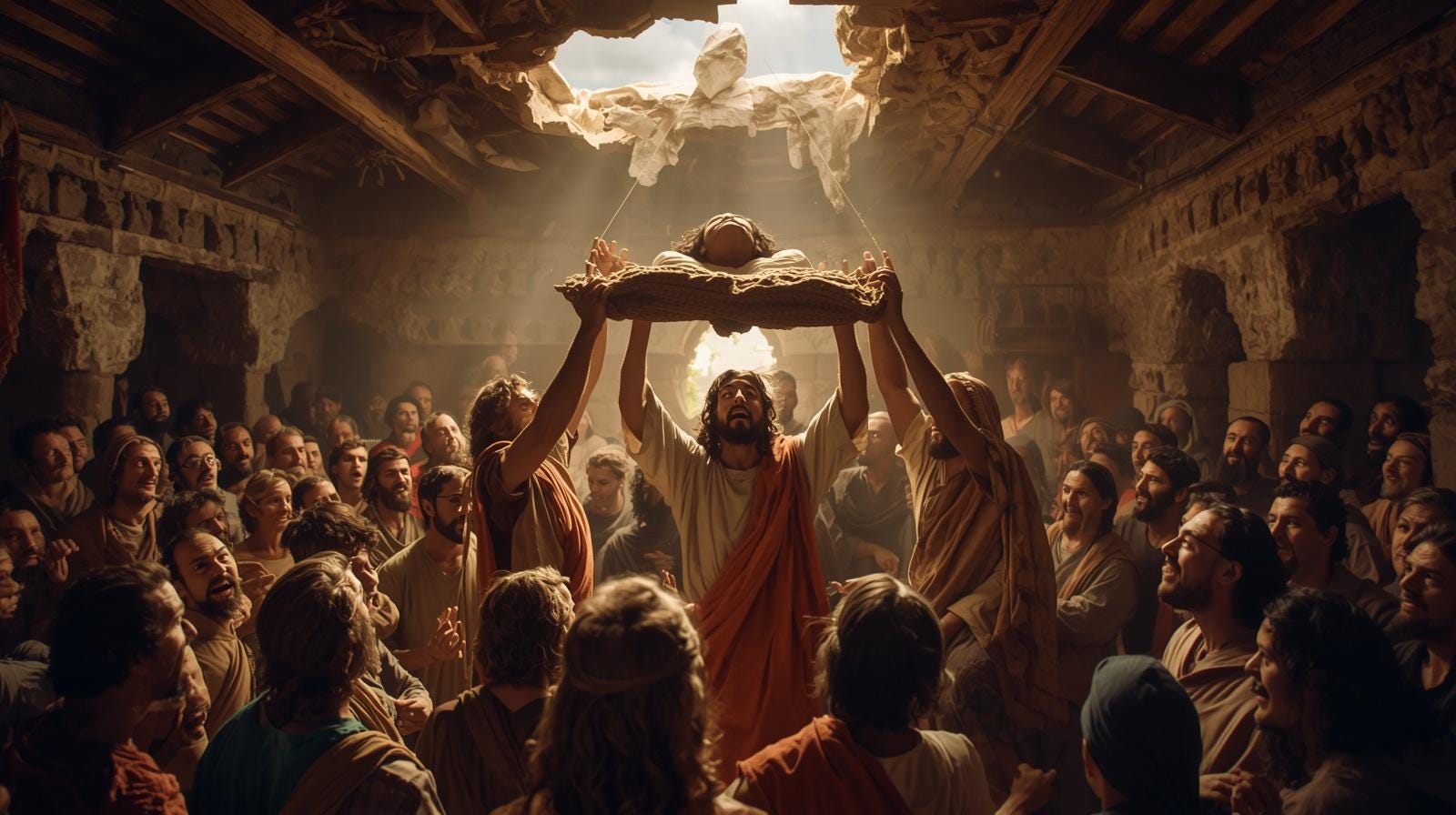
Jesus is in a house in Capernaum. The crowd is so thick that four men, carrying their paralyzed friend on a mat, cannot get through the door. So they go up to the roof, break through it, and lower the man down into the middle of the room — directly in front of Jesus.
What happens next surprises everyone.
Jesus looks at the man and says — your sins are forgiven.
Not get up and walk. Not a word about the paralysis that brought the man here in the first place. Forgiveness. The scribes sitting nearby hear it and something hardens in them immediately. This is blasphemy. Only God can forgive sins. Who does this man think He is?
They do not say it out loud. But Jesus knows.
Immediately Jesus knew in his spirit that this was what they were thinking in their hearts.
This detail is not incidental. Before the miracle, before the confrontation, the text establishes something about who Jesus is. He does not need the scribes to voice their objection. He already knows it. He sees into the room behind the face — into the place where the real response is being formed before it ever becomes words.
This is the same Jesus who is being asked to prove Himself. And He already knows everything about the people doing the asking.
The Question He Asked
Jesus does not defend Himself. He asks a question.
Which is easier — to say to this paralyzed man, your sins are forgiven, or to say, get up, take your mat and walk?
It is a question worth sitting with, because the answer is not as obvious as it first appears.
On the surface, saying your sins are forgiven seems easier. It is invisible. There is no immediate way to verify it. You can say it and no one can prove you wrong on the spot. Saying get up and walk is verifiable in seconds. Either the man gets up or he does not. The word is immediately tested by reality.
But Jesus is pointing at something deeper than that. Forgiving sins is not easier in any ultimate sense — it is infinitely harder. It requires actual authority over the moral fabric of the universe. It requires the standing to cancel a debt that is owed not to the person speaking but to God. No human being has that standing. No prophet, no priest, no teacher.
The healing of a paralyzed body is a remarkable thing. But it is a physical thing — located in time and space, visible and temporary. Forgiveness of sins reaches into something that outlasts the body entirely. It addresses the deepest rupture in a human life — the separation from God that no physician and no religious system and no amount of moral effort has ever been able to fully close.
Jesus is saying — if I can do the harder thing, the visible thing will follow. Watch.
Authority on Earth
I want you to know that the Son of Man has authority on earth to forgive sins.
This is the centre of the passage and it is worth staying here for a moment.
The scribes were not wrong about the principle. Forgiveness of sins is God’s domain. Their mistake was not in the theology — it was in failing to recognise who was standing in front of them. They had the right understanding of what forgiveness requires. They had the wrong conclusion about whether Jesus had what it requires.
The phrase Son of Man is a deliberate choice. It reaches back to Daniel 7 — to the figure who comes before the Ancient of Days and is given authority and glory and sovereign power. It is a claim wrapped in a title. Jesus is not merely a teacher with opinions about sin. He is the One to whom authority has been given. Authority that includes — that centrally includes — the authority to forgive.
And He exercises that authority on earth. Not from a distance. Not through a religious system or a mediating institution. Here, in a crowded house, looking at a man who was lowered through the roof by his friends. The authority of heaven brought all the way down to the level of one paralyzed man on a mat.
Get Up
Then He turns back to the man.
I tell you, get up, take your mat and go home.
The man gets up. Takes his mat. Walks out. In full view of everyone in the room.
The mat is a detail worth noticing. Jesus tells him to take it with him. The thing that had carried him — the symbol of his helplessness, the object that defined his condition — he now carries instead. What bore him becomes what he bears. The evidence of his paralysis becomes something he walks out with in his hands, in front of the same crowd that watched him lowered through the roof.
There is something in that image about what genuine transformation looks like. The past is not erased — the mat still exists. But its meaning has been completely reversed. It is no longer a sign of what he cannot do. It is a testimony to what God did.
We Have Never Seen Anything Like This
The crowd’s response is wonder and praise.
They praised God, saying — we have never seen anything like this.
Not praise for Jesus in the way we might expect. Praise for God. The miracle points past itself to its source. The amazement does not stop at the surface of the extraordinary thing they have just witnessed — it travels all the way to the One from whom that extraordinary thing came.
This is the right response to a genuine encounter with the power of God. Not simply amazement at the event itself but worship directed toward the One who stands behind it. The crowd understood instinctively that what they had seen was not a human achievement. It was a window into something larger than the room they were standing in.
The scribes came in looking for something to argue about. The crowd went out with praise on their lips. Same event. Completely different posture going in.
The Deeper Healing
It is easy to read this passage and fix your attention on the physical miracle. The paralyzed man walks. That is astonishing and it is meant to be.
But Jesus was clear about what He considered the more significant thing. The healing of the body was the sign. The forgiveness of sins was the substance. The man walked out of that house carrying his mat — but he also walked out carrying something invisible and infinitely more valuable. The weight that no physician had ever been able to lift. The separation from God that his paralysis had perhaps led him to wonder about. Cancelled. By the One who has authority on earth to do exactly that.
This is what Jesus came to do. Not primarily to heal bodies — though He healed many. But to address the rupture at the root of every human problem. The thing underneath the paralysis, and underneath every other condition we carry. The broken relationship with God that no amount of religious effort or moral improvement has ever been able to fully repair.
He forgives it. On earth. In a crowded house. In full view of everyone.
Walk On
The man in this passage had friends who refused to let an obstacle stop them. When the door was blocked they went through the roof. Their determination to get their friend in front of Jesus is part of what the passage shows us — faith that acts, that finds a way, that does not accept the crowd at the door as a final answer.
But the more important thing is what happened when he got there.
Jesus saw him. Knew him. Addressed the deepest thing first. And then told him to get up.
Whatever has been keeping you on the mat — whatever condition, whatever weight, whatever history — the authority that forgave and healed that man in Capernaum has not diminished. The Son of Man still has authority on earth to forgive sins. That authority is not located in a building or a system or a set of requirements you have to meet first.
It is located in Him. And He is not difficult to find.
Get up. Take your mat. Go home.
All glory to God — forever and ever. Amen. 🤍
If this reflection spoke to you, consider subscribing to follow along my journey of faith, meditation, and rebuilding — one day at a time. Your support truly means more than you know. ❤️